How Many Liters in a Gram?
0.001 L
1 gram of water takes up 0.001 liter. Lighter or denser ingredients take up more or less, so pick yours in the converter.
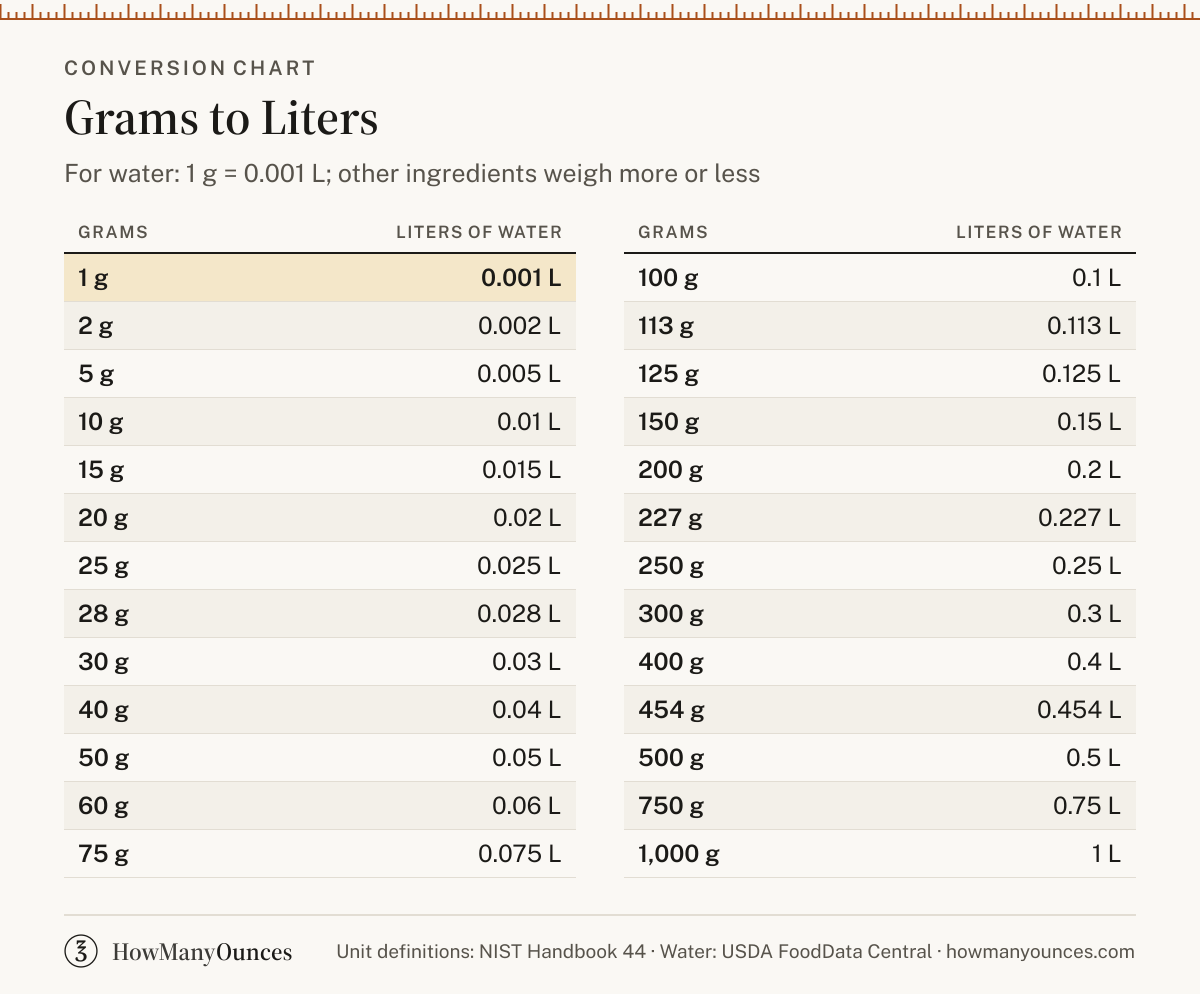
Grams to Liters conversion chart
| Grams | Liters (water) |
|---|---|
| 1 g | 0.001 |
| 2 g | 0.002 |
| 5 g | 0.005 |
| 10 g | 0.01 |
| 15 g | 0.015 |
| 20 g | 0.02 |
| 25 g | 0.025 |
| 28 g | 0.028 |
| 30 g | 0.03 |
| 40 g | 0.04 |
| 50 g | 0.05 |
| 60 g | 0.06 |
| 75 g | 0.075 |
| 100 g | 0.1 |
| 113 g | 0.113 |
| 125 g | 0.125 |
| 150 g | 0.15 |
| 200 g | 0.2 |
| 227 g | 0.227 |
| 250 g | 0.25 |
| 300 g | 0.3 |
| 400 g | 0.4 |
| 454 g | 0.454 |
| 500 g | 0.5 |
| 750 g | 0.75 |
| 1,000 g | 1 |
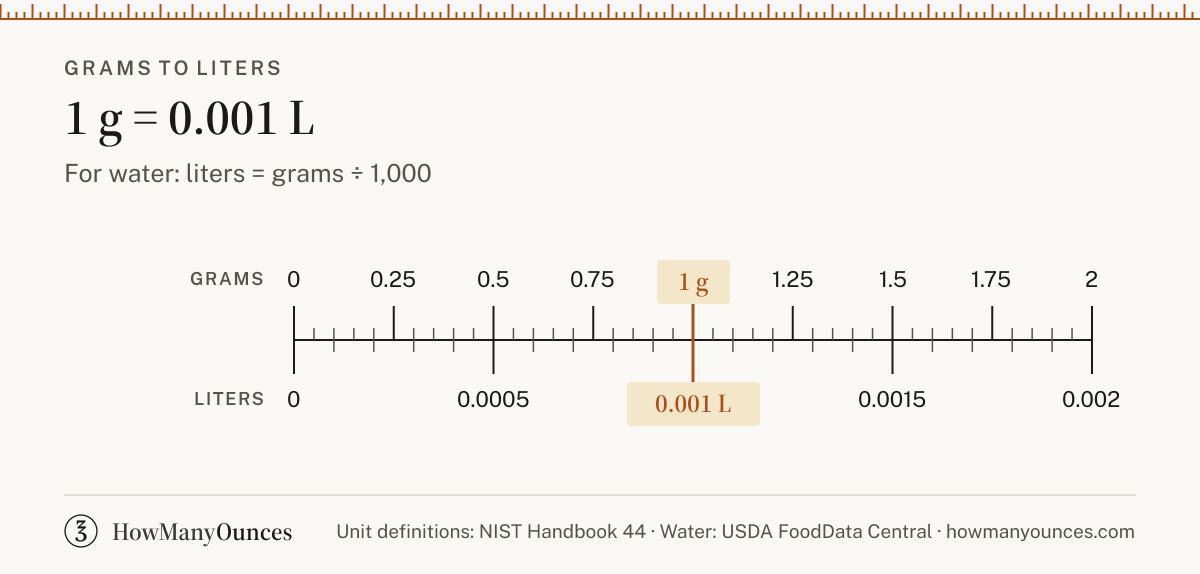
How to convert grams to liters
liters = grams ÷ 1,000
Example: 250 g ÷ 1,000 = 0.25 L.
Divide the grams by how many grams one liter of the ingredient weighs. For water that number is 1,000, which is why the formula above only moves the decimal point three places to the left.
Other foods need their own number. A liter of whole milk weighs about 1,031 grams and a liter of granulated sugar about 845 grams. So 1,500 g of sugar takes up 1,500 ÷ 845 = 1.77 liters.
A gram is tiny next to a liter, so results for small amounts come out as long decimals. For anything under about a hundred grams, grams to milliliters gives numbers that are easier to read.
Why weight depends on the ingredient
A liter is a fixed box of space, and grams count what is inside it. Water fills that box with 1,000 grams by the USDA figure this site uses. Most other kitchen staples do not match it.
All-purpose flour packs only about 528 grams into a liter, so each gram of flour needs almost twice the room of a gram of water. Butter comes much closer to water, at about 959 grams per liter.
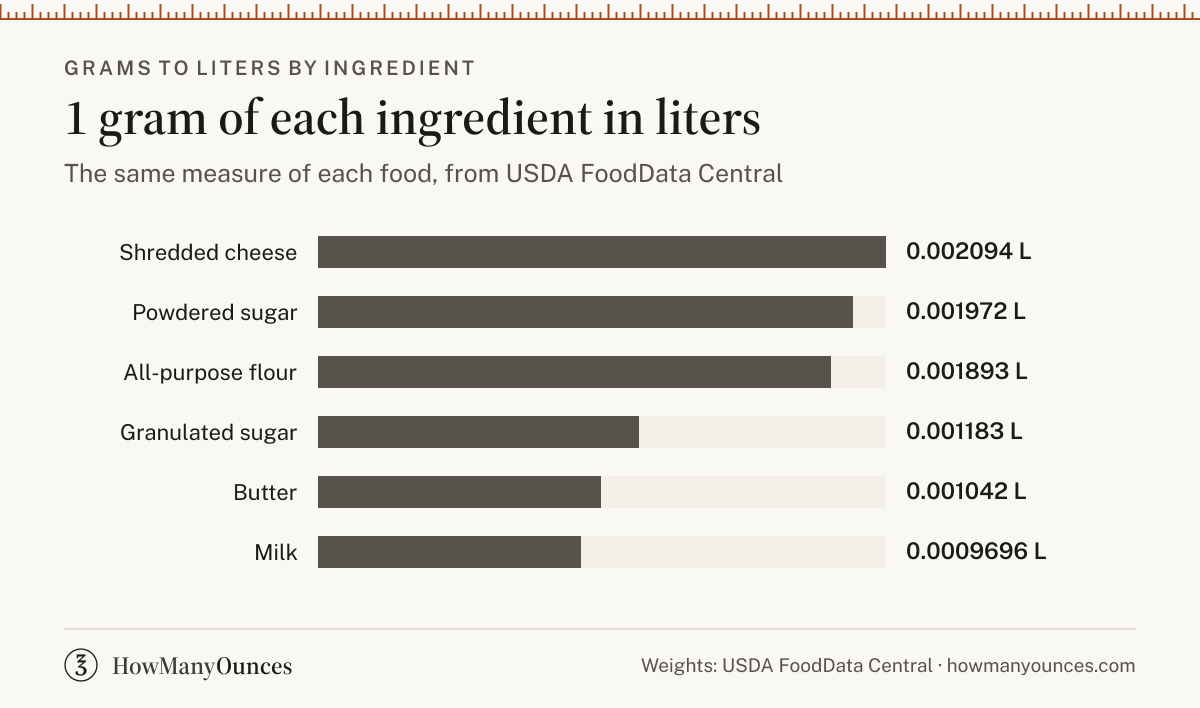
| Ingredient | 1 g = |
|---|---|
| All-purpose flour | 0.001893 L |
| Granulated sugar | 0.001183 L |
| Butter | 0.001042 L |
| Milk | 0.0009696 L |
| Powdered sugar | 0.001972 L |
| Shredded cheese | 0.002094 L |
Will it fit in the jar?
When a storage jar shows its capacity in liters and the bag of food gives grams, divide before you pour. A 750 g bag of granulated sugar needs about 0.887 liters, so it fits a 1 L jar with room to spare.
The same 750 g of all-purpose flour needs about 1.42 liters and will overflow that jar. Leave some headroom in any case, since poured flour heaps up unevenly before it settles.
Grams and liters: questions
Is 1 gram equal to 1 liter?
No. A gram of water fills one milliliter, and a liter holds a thousand milliliters. It takes a whole kilogram of water to fill a liter, and even more grams of a heavier liquid, such as milk.
How many liters is 500 grams?
Half a liter if it is water. 500 g of all-purpose flour takes up about 0.946 liters, nearly a full liter, while the same weight of granulated sugar needs about 0.591 liters.
What does g/L mean?
It means grams per liter, the number of grams of something mixed into each liter of liquid. It describes how strong a mixture is, such as 50 g of salt in every liter of a brine. It is not a way to convert grams into liters.
How many liters is 1 gram of flour?
About 0.00189 liters, a number so small that milliliters work better. In those units, a gram of all-purpose flour takes up about 1.89 milliliters, close to twice the space of a gram of water.
How do I convert grams to liters for any ingredient?
Divide the grams by that ingredient's weight per liter. Use 1,000 for water, about 1,031 for whole milk, 845 for sugar and 528 for flour. For other foods, pick the ingredient in the converter above.
Related conversions
Sources: Unit definitions: NIST Handbook 44 · Densities: USDA FoodData Central · Last reviewed · Report an error
https://howmanyounces.com/grams-to-liters/