How Many Milliliters in a Gram?
1 ml
1 gram of water takes up 1 milliliter. Lighter or denser ingredients take up more or less, so pick yours in the converter.
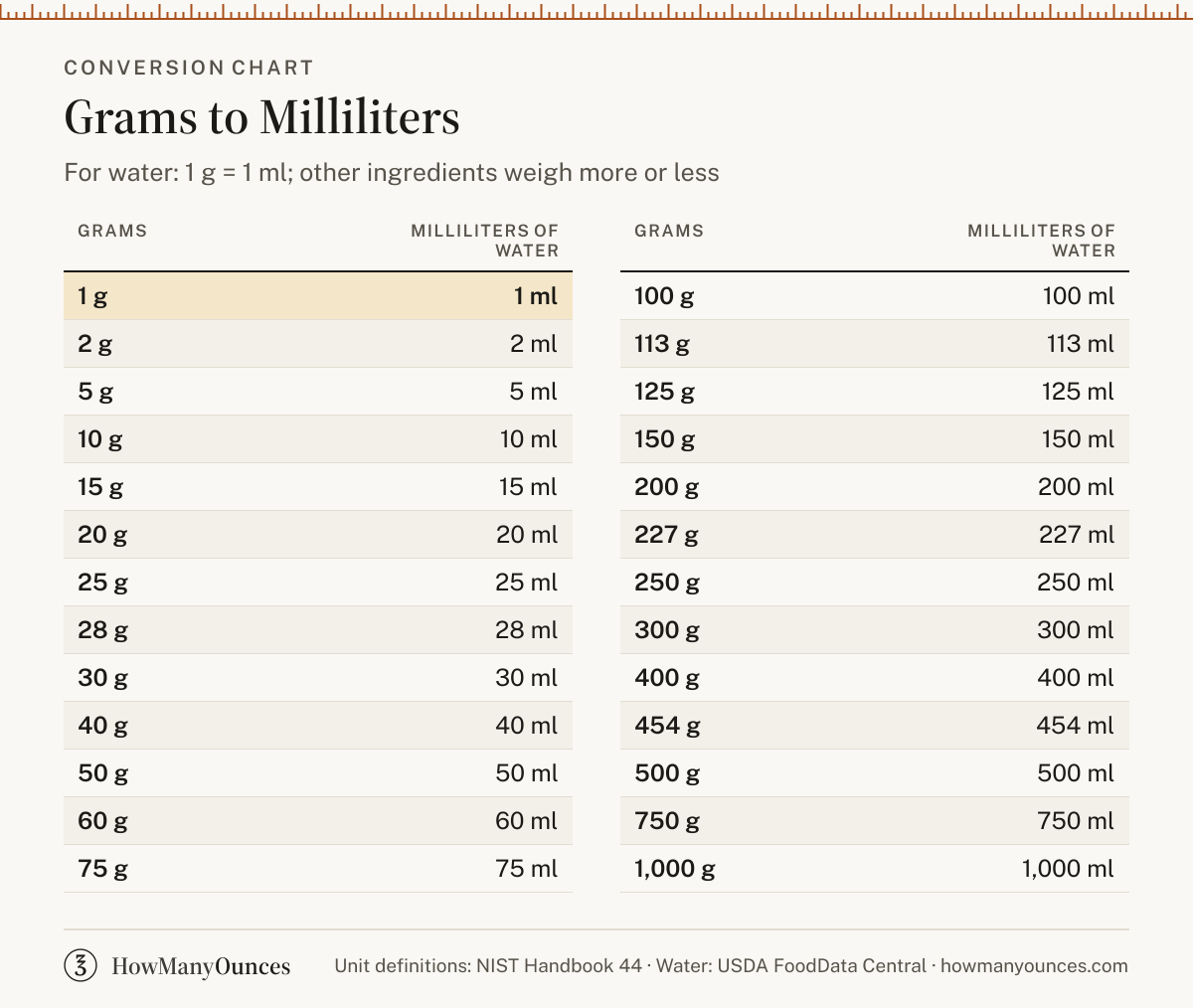
Grams to Milliliters conversion chart
| Grams | Milliliters (water) |
|---|---|
| 1 g | 1 |
| 2 g | 2 |
| 5 g | 5 |
| 10 g | 10 |
| 15 g | 15 |
| 20 g | 20 |
| 25 g | 25 |
| 28 g | 28 |
| 30 g | 30 |
| 40 g | 40 |
| 50 g | 50 |
| 60 g | 60 |
| 75 g | 75 |
| 100 g | 100 |
| 113 g | 113 |
| 125 g | 125 |
| 150 g | 150 |
| 200 g | 200 |
| 227 g | 227 |
| 250 g | 250 |
| 300 g | 300 |
| 400 g | 400 |
| 454 g | 454 |
| 500 g | 500 |
| 750 g | 750 |
| 1,000 g | 1,000 |
How to convert grams to milliliters
milliliters = grams × 1
Example: 250 g × 1 = 250 ml.
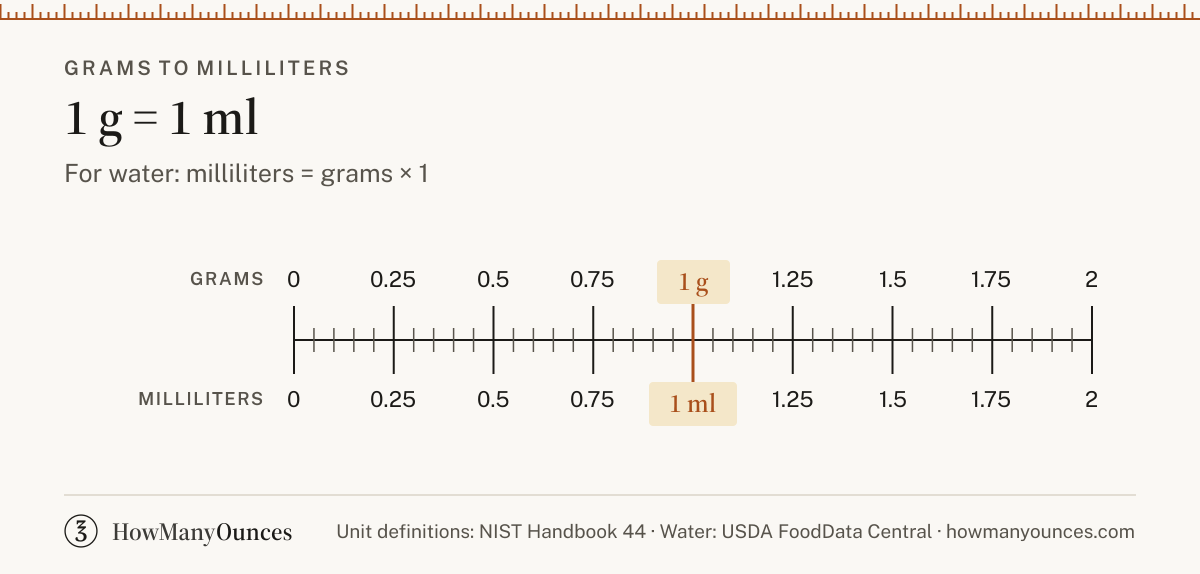
Divide the grams by the ingredient's density in grams per milliliter. Water's density is 1, so for water the gram count and the milliliter count are the same number.
Milk is a little denser, at about 1.03 grams per milliliter. For 400 g of whole milk, the jug needs 400 ÷ 1.03 = 388 milliliters, slightly less than the gram figure.
Dry foods have a density well under one, so their milliliters come out higher than their grams. The converter above holds the densities for flour, sugar, butter and more.
Why weight depends on the ingredient
Only water gives a one-to-one answer here. A gram is a fixed amount of matter and a milliliter is a fixed amount of space, and how much space a gram takes depends on the food.
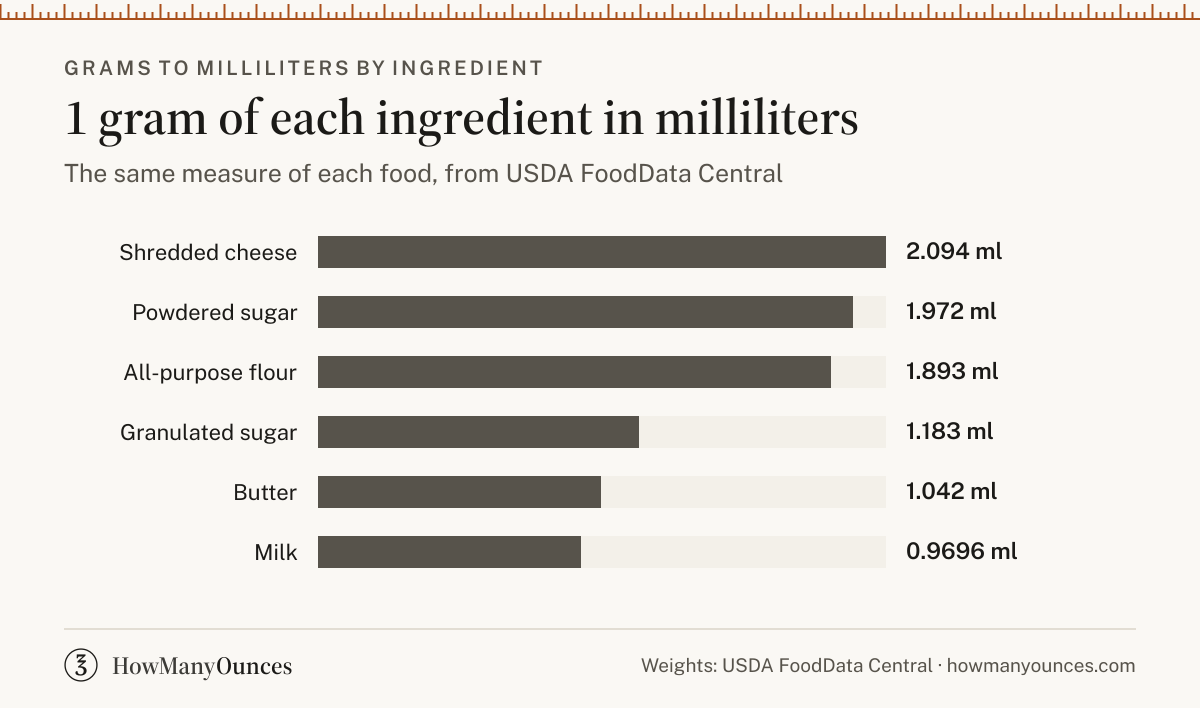
100 g of granulated sugar fills about 118 milliliters, and 100 g of shredded cheese about 209 milliliters. Butter lands near water but still needs a little more room, about 104 milliliters for every 100 g.
| Ingredient | 1 g = |
|---|---|
| All-purpose flour | 1.893 ml |
| Granulated sugar | 1.183 ml |
| Butter | 1.042 ml |
| Milk | 0.9696 ml |
| Powdered sugar | 1.972 ml |
| Shredded cheese | 2.094 ml |
Using a measuring jug for a recipe in grams
Without a scale, the milliliter marks on a jug can stand in for grams when the ingredient is a liquid. For water, pour to the same number as the grams. For milk, stop a little below it, since each milliliter of milk weighs slightly more than a gram.
A jug works poorly for dry ingredients. Flour and sugar settle into uneven heaps, so the marks give only a rough amount. For small quantities, spoons are more reliable, and the grams to tablespoons page lists the numbers.
Grams and milliliters: questions
Is 1 gram equal to 1 ml?
Only for water and liquids that weigh the same. Milk is slightly heavier, so a gram of it fills about 0.97 milliliters. All-purpose flour is much lighter for its size, and a gram of it takes up about 1.89 milliliters.
How many ml is 100 grams of milk?
About 97 milliliters of whole milk, using the USDA cup weight. That is a few milliliters under the gram figure. For most cooking you can pour 100 ml and never notice, but in a large batch the gap adds up.
How many ml is 100 grams of flour?
About 189 milliliters of all-purpose flour, nearly twice the gram number. Flour is light and fluffy, so it needs far more room per gram than water does. Spoon it loosely into the measure and level the top for the closest match.
Is a milliliter the same as a cc?
Yes. One milliliter is exactly one cubic centimeter, often written cc or cm³. So for water, a gram, a milliliter and a cubic centimeter all describe the same small amount.
How many ml is 50 grams of sugar?
About 59 milliliters of granulated sugar, which happens to match a US quarter cup (59 ml). So when a recipe lists 50 g of sugar and you have no scale, a level quarter cup is a close stand-in. The grams to cups page covers other amounts.
Related conversions
Sources: Unit definitions: NIST Handbook 44 · Densities: USDA FoodData Central · Last reviewed · Report an error
https://howmanyounces.com/grams-to-milliliters/