How Many Milligrams in a Gram?
1,000 mg
There are 1,000 milligrams in 1 gram.
Exact: 1 g = 1,000 mg
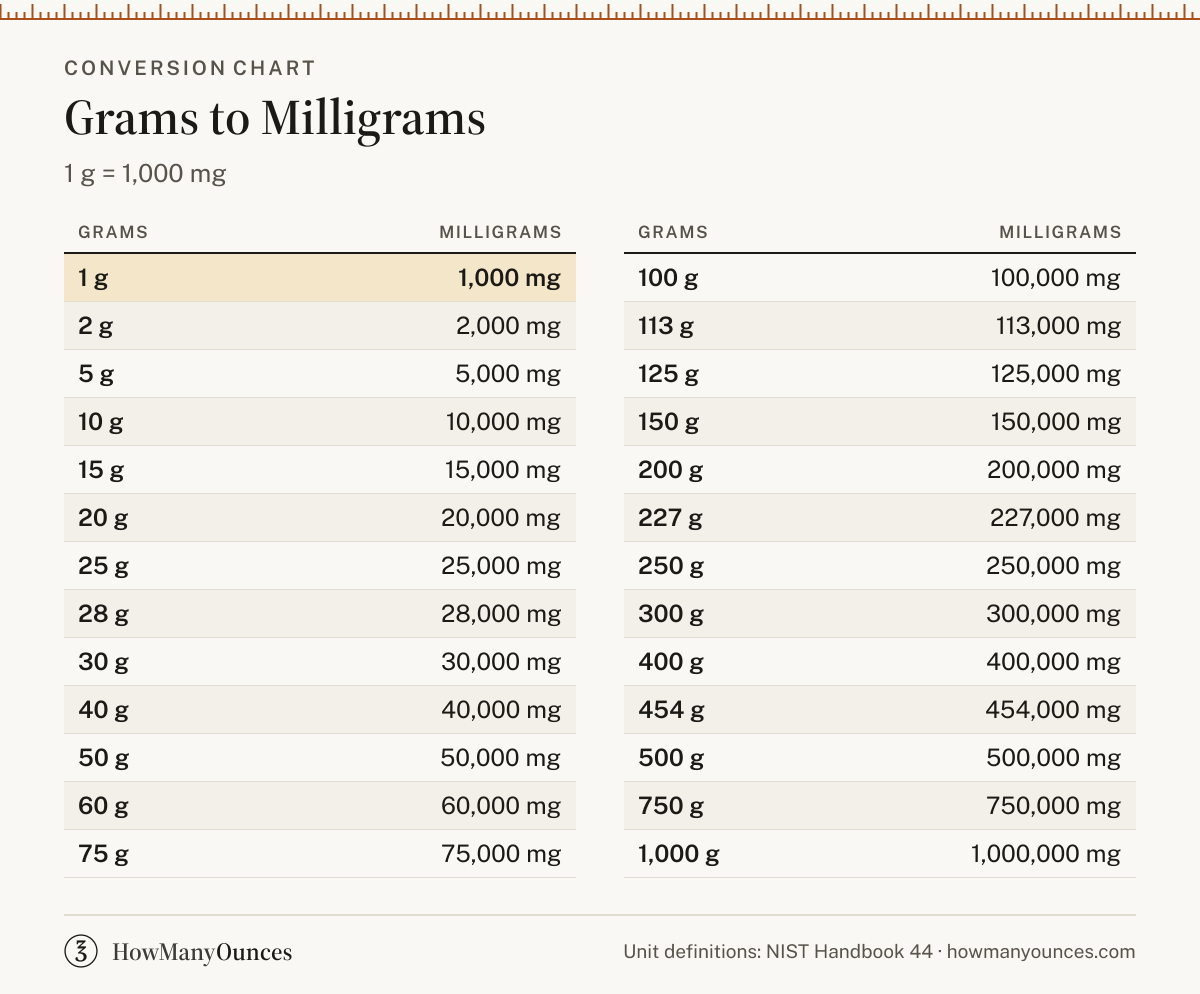
Grams to Milligrams conversion chart
| Grams | Milligrams |
|---|---|
| 1 g | 1,000 |
| 2 g | 2,000 |
| 5 g | 5,000 |
| 10 g | 10,000 |
| 15 g | 15,000 |
| 20 g | 20,000 |
| 25 g | 25,000 |
| 28 g | 28,000 |
| 30 g | 30,000 |
| 40 g | 40,000 |
| 50 g | 50,000 |
| 60 g | 60,000 |
| 75 g | 75,000 |
| 100 g | 100,000 |
| 113 g | 113,000 |
| 125 g | 125,000 |
| 150 g | 150,000 |
| 200 g | 200,000 |
| 227 g | 227,000 |
| 250 g | 250,000 |
| 300 g | 300,000 |
| 400 g | 400,000 |
| 454 g | 454,000 |
| 500 g | 500,000 |
| 750 g | 750,000 |
| 1,000 g | 1,000,000 |
How to convert grams to milligrams
milligrams = grams × 1,000
Example: 250 g × 1,000 = 250,000 mg.
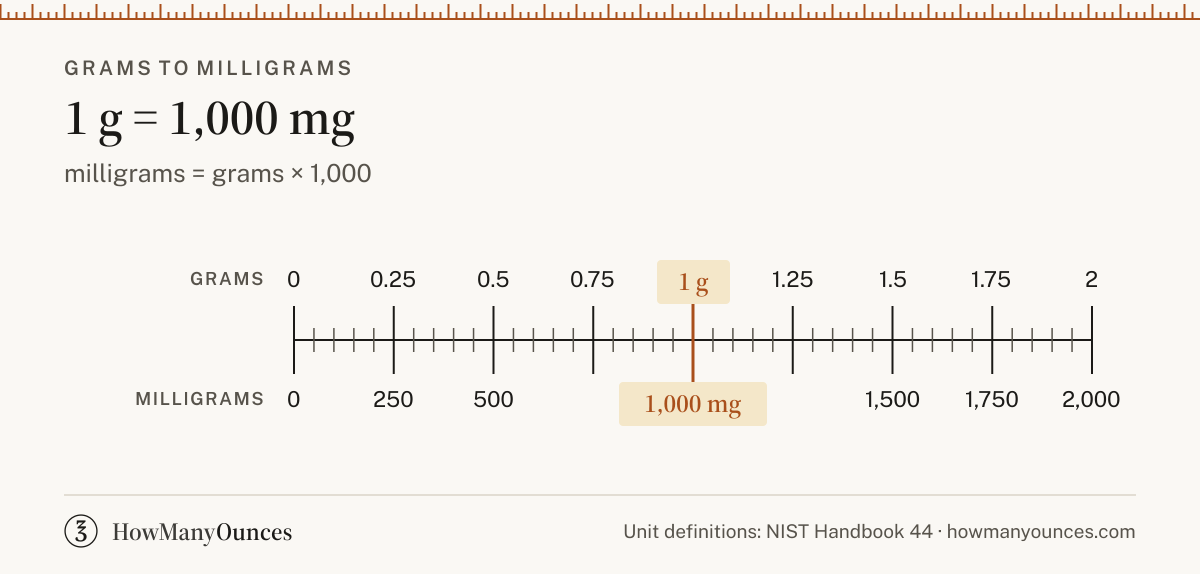
Multiply by 1,000. For whole grams, that just adds three zeros, so 3 g is 3,000 mg. With decimals, the point jumps three spots to the right: 1.5 g is 1,500 mg, 0.25 g is 250 mg and 0.04 g is 40 mg.
Check the size of the answer. The milligram number should always be larger than the gram number, because the prefix milli means one thousandth, as NIST's table of metric prefixes shows. If your result shrank, you divided instead of multiplying.
How to compare grams and milligrams on a food label
Nutrition Facts labels mix the two units. The FDA's Daily Value table lists fat, protein and fiber in grams, but sodium and calcium in milligrams.
To compare two lines, put them in the same unit first. 0.6 g is 600 mg, so it matches a line that reads 600 mg, even though the numbers look a thousand times apart.
Scales follow the same logic. One that shows two decimal places in grams moves in steps of 10 mg; to see single milligrams, it needs three decimal places.
Converting a scaled-down recipe to milligrams
When you shrink a recipe, small gram amounts turn into fractions of a gram. A quarter batch of a dough that uses 2 g of instant yeast needs 500 mg, and a tenth of 3 g of citric acid is 300 mg.
Amounts like these are easier to weigh in milligrams on a fine scale than to guess with spoons. Write the milligram figure next to the original gram amount so the scaled recipe stays easy to check.
Grams and milligrams: questions
How many milligrams are in 0.1 g?
0.1 g is 100 mg. A tenth of a gram sounds small, but in milligrams it becomes a three-digit number that is easier to read and compare. Half of it, 0.05 g, is 50 mg.
How many mg is 2.5 g?
2.5 g is 2,500 mg. Move the point three places to the right and add two zeros, because 2.5 has only one digit after the point to begin with. To check, divide 2500 by 1,000: you should land back on 2.5.
Is 1,000 mg the same as 1 g?
Yes. 1,000 mg and 1 g are the same weight written with different prefixes. Going past that point, 2,500 mg can also be written as 2.5 g; see milligrams to grams.
How many milligrams are in a kilogram?
A kilogram is 1,000,000 mg, a million milligrams. It holds 1,000 grams, and each of those holds 1,000 milligrams. That is why weights this large stay in grams or kilograms, while milligrams suit small amounts such as a pinch of spice.
How many milligrams are in a teaspoon?
It depends on what is in the spoon, because a teaspoon measures volume. A US teaspoon of water weighs about 4,929 mg.
Using USDA cup weights, the same spoon of all-purpose flour weighs only about 2,604 mg. The grams to teaspoons converter handles other ingredients.
Related conversions
Sources: Unit definitions: NIST Handbook 44 · Last reviewed · Report an error
https://howmanyounces.com/grams-to-milligrams/