How Many Ounces of Water Should You Drink a Day?
74–101 fl oz
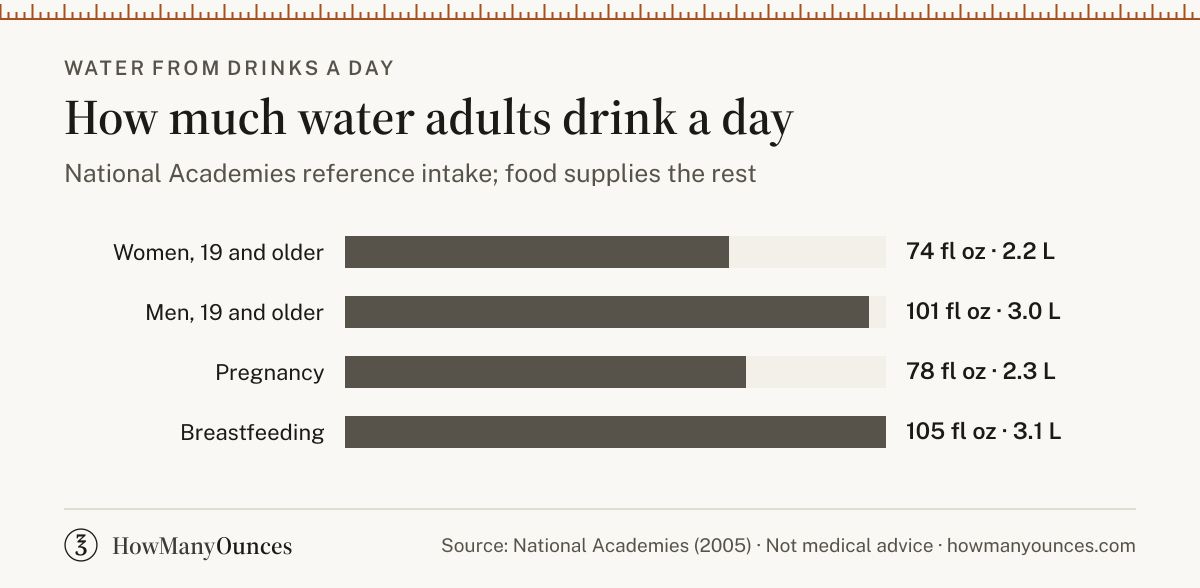
of drinks a day for healthy adult women and men (2.2 and 3.0 L), from the National Academies reference intake. Food supplies the rest of the total water of 2.7 and 3.7 L.
Daily water by group
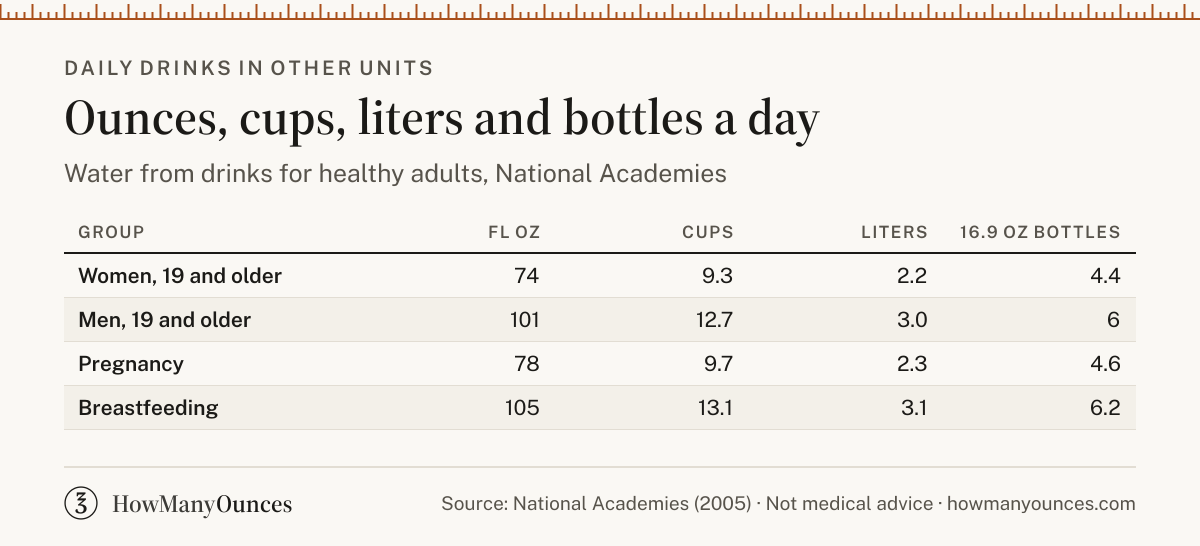
| Group | Total water | From drinks | Drinks in fl oz | Cups | 16.9 oz bottles |
|---|---|---|---|---|---|
| Women, 19 and older | 2.7 L | 2.2 L | 74 fl oz | 9.3 | 4.4 |
| Men, 19 and older | 3.7 L | 3.0 L | 101 fl oz | 12.7 | 6 |
| Pregnancy | 3.0 L | 2.3 L | 78 fl oz | 9.7 | 4.6 |
| Breastfeeding | 3.8 L | 3.1 L | 105 fl oz | 13.1 | 6.2 |
How the calculator works
The calculator shows two estimates side by side. The first comes from the reference values for water set by the National Academies for healthy adults. The second is a popular rule of thumb: drink half your body weight in pounds as fluid ounces.
Both results are shown in fluid ounces, cups, liters and bottles of 16.9 fl oz, the size of a common 500 ml bottle of water. The table under the results splits the daily amount evenly over the day, as an example rather than a rule.
What the National Academies numbers mean
The National Academies set an Adequate Intake of total water of 3.7 liters a day for men and 2.7 liters for women. Total water counts everything: plain water, other drinks and the water in food.
About 80% of it usually comes from drinks. That is about 101 fl oz (3 L) of drinks a day for men and 74 fl oz (2.2 L) for women, and it is the number the calculator shows first.
The values are based on how much healthy people actually drink, not on a measured need. The report says they "should not be interpreted as a specific requirement", and that most healthy people get enough by drinking when thirsty and with meals.
Pregnancy and breastfeeding
The reference goes up to 3 liters of total water a day during pregnancy, about 2.3 L of it from drinks. While breastfeeding it is 3.8 liters, about 3.1 L from drinks.
These values apply from age 14 to 50. For anything specific to your pregnancy, ask your doctor or midwife.
The half-your-weight rule
Many extension services and health columns repeat a simple rule: drink half your body weight in pounds as ounces of water, for example Rutgers Cooperative Extension and the University of Georgia. The calculator uses 0.5 fl oz per pound.
We found no health agency that sets a water target by body weight, so treat this as a rough guide. Michigan State University Extension gives a wider range of half an ounce to one ounce per pound, which shows how loose the rule is.
Exercise and hot weather
Exercise and heat both raise how much water you need. For exercise, the American College of Sports Medicine suggests a starting range of 0.4 liter to 0.8 liter per hour for marathon runners, or about 14 to 27 fl oz.
The lower end fits slower, lighter people in cool weather and the upper end faster, heavier people in warm weather. Sweat rates differ a lot, so the ACSM recommends a personal plan based on weighing yourself before and after exercise, and you should not drink more than you sweat.
For work in the heat, NIOSH advises one cup (8 fl oz) of water every 15 to 20 minutes and never more than 48 fl oz in an hour. The National Academies note that very active people who are always in hot weather often need 6 liters or more of total water a day.
When to ask a doctor instead
This calculator is for healthy adults. People with heart failure, or with kidney failure treated by dialysis, often have to limit how much they drink, as MedlinePlus and the NIDDK explain. Advanced liver disease can call for limits too.
Drinking far more than you need is rare but can be dangerous. The kidneys can clear only about 0.7 L to 1 L of water an hour, and drinking much faster than that can lower the salt in your blood.
Drinking water: questions
How many ounces of water should I drink a day?
The National Academies reference comes to about 74 fl oz of drinks a day for women and 101 fl oz for men, including water, milk, tea and coffee. Food supplies the rest of the total. Your own needs change with exercise, heat and health.
Is 64 oz of water a day enough?
For many healthy adults it can be, because food and other drinks add to it. 64 fl oz is 8 cups, or 1.9 L, a little below the drinks reference of 2.2 L for women and 3 L for men. The reference is not a minimum, and thirst is a good guide for most healthy people.
Is 100 oz of water a day too much?
Not for most healthy adults if you spread it over the day. 100 fl oz is about 3 L, close to the drinks reference for men. The risk comes from drinking very large amounts quickly, or from a condition that limits fluids.
Do tea and coffee count toward my water?
Yes. The National Academies count all drinks, including those with caffeine, toward total water. The NHS also counts lower-fat milk and sugar-free drinks, including tea and coffee.
How many bottles of water is that?
A common bottle holds 16.9 fl oz. The drinks reference comes to about 4.4 bottles a day for women and 6 for men.
Based on guidance from
- National Academies of Sciences, Engineering, and Medicine (Institute of Medicine): Dietary Reference Intakes for Water, Potassium, Sodium, Chloride, and Sulfate, chapter 4: Water (2005), checked
- National Academies: Report sets dietary intake levels for water, salt, and potassium (news release, 2004), checked
- American College of Sports Medicine: Exercise and fluid replacement, position stand (2007), checked
- NIOSH, Centers for Disease Control and Prevention: Heat stress: hydration (2017), checked
- NHS: Water, drinks and hydration, checked
- MedlinePlus, US National Library of Medicine: Water in diet, checked
- MedlinePlus, US National Library of Medicine: Heart failure: fluids and diuretics, checked
- National Institute of Diabetes and Digestive and Kidney Diseases: Eating and nutrition for hemodialysis, checked
- Rutgers Cooperative Extension: Hydrate at the right rate (2016), checked
- University of Georgia Cooperative Extension: How much water should you drink? (2022), checked
- Michigan State University Extension: Healthy hydration (2018), checked
Related
Sources: Sources listed above · Last reviewed · Report an error
https://howmanyounces.com/tools/water-intake-calculator/