Grams to Fluid Ounces (g to fl oz)
0.03381 fl oz
1 gram of water takes up 0.03381 fluid ounce. Lighter or denser ingredients take up more or less, so pick yours in the converter.
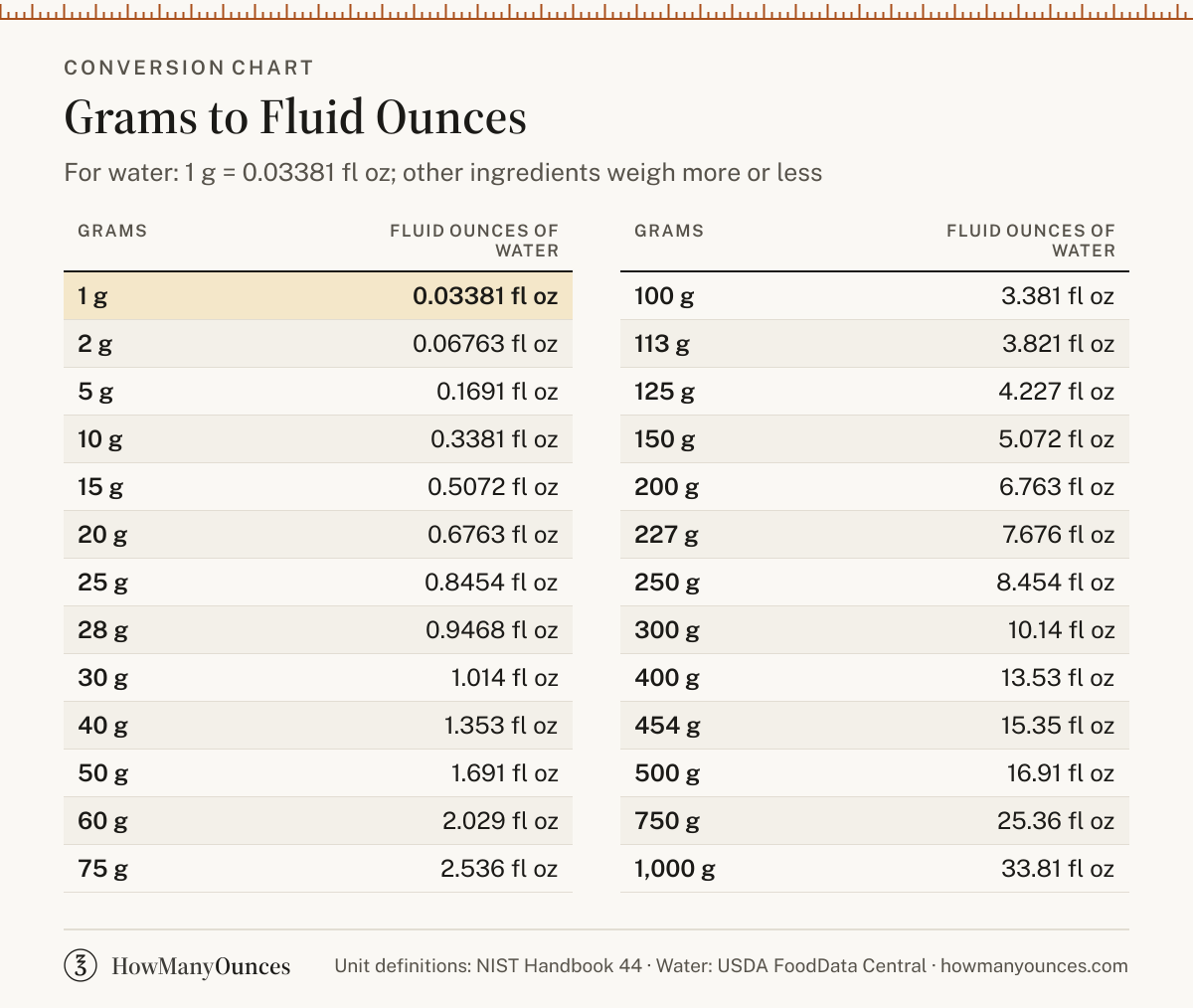
Grams to Fluid Ounces conversion chart
| Grams | Fluid Ounces (water) |
|---|---|
| 1 g | 0.03381 |
| 2 g | 0.06763 |
| 5 g | 0.1691 |
| 10 g | 0.3381 |
| 15 g | 0.5072 |
| 20 g | 0.6763 |
| 25 g | 0.8454 |
| 28 g | 0.9468 |
| 30 g | 1.014 |
| 40 g | 1.353 |
| 50 g | 1.691 |
| 60 g | 2.029 |
| 75 g | 2.536 |
| 100 g | 3.381 |
| 113 g | 3.821 |
| 125 g | 4.227 |
| 150 g | 5.072 |
| 200 g | 6.763 |
| 227 g | 7.676 |
| 250 g | 8.454 |
| 300 g | 10.14 |
| 400 g | 13.53 |
| 454 g | 15.35 |
| 500 g | 16.91 |
| 750 g | 25.36 |
| 1,000 g | 33.81 |
How to convert grams to fluid ounces
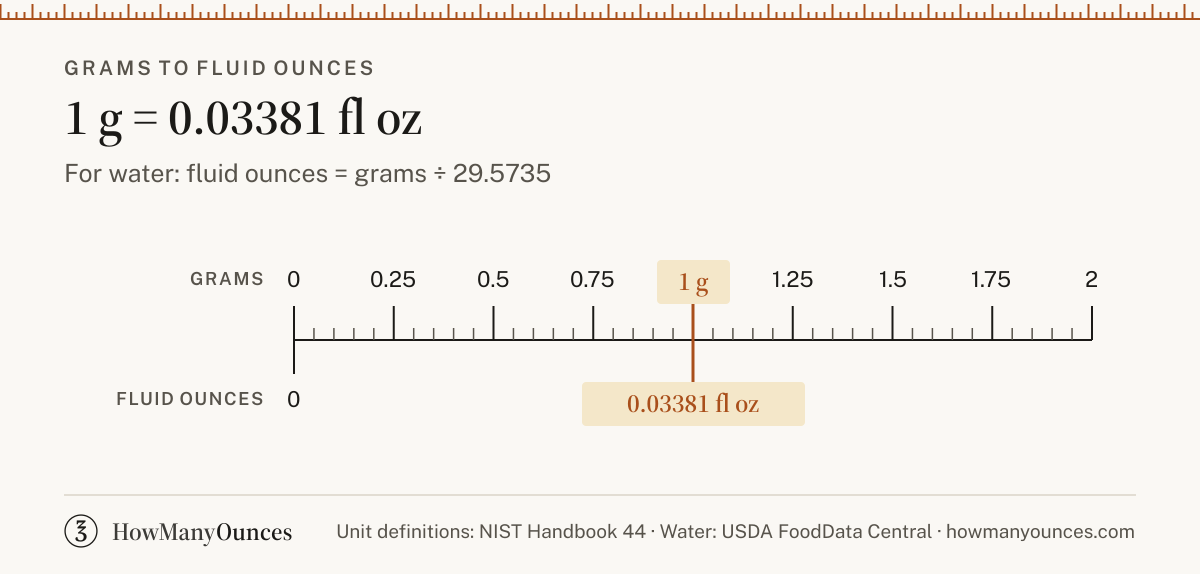
fluid ounces = grams ÷ 29.5735
Example: 250 g ÷ 29.5735 = 8.454 fl oz.
Every ingredient has its own divisor: the grams that one US fluid ounce of it weighs. Water's divisor is the one in the formula above. For whole milk it is about 30.5.
So 300 g of whole milk works out to 300 ÷ 30.5 = 9.84 fluid ounces. With that number in hand, a measuring cup marked in fluid ounces does the rest: fill it to just under the 10 fl oz line.
For powders and other dry foods the divisor is much smaller, so the fluid ounces come out much higher. Look up the ingredient in the table below or pick it in the converter.
US vs UK fluid ounces
An imperial fluid ounce holds a little less than a US one, so the same grams make slightly more imperial fluid ounces. 500 g of water is about 17.6 imperial fluid ounces, but 16.9 US fluid ounces.
If your measuring jug is marked with both scales, read the one that matches the country of your recipe. Otherwise, milliliters are the safer middle ground, since they mean the same everywhere.
| Unit | Size | Used in |
|---|---|---|
| US fluid ounce | 29.57 ml | US |
| imperial fluid ounce | 28.41 ml | UK |
Why weight depends on the ingredient
Grams tell you how much of a food you have, and fluid ounces tell you how much room it takes. A liquid a bit heavier than water, such as milk, needs slightly fewer fluid ounces for the same grams.
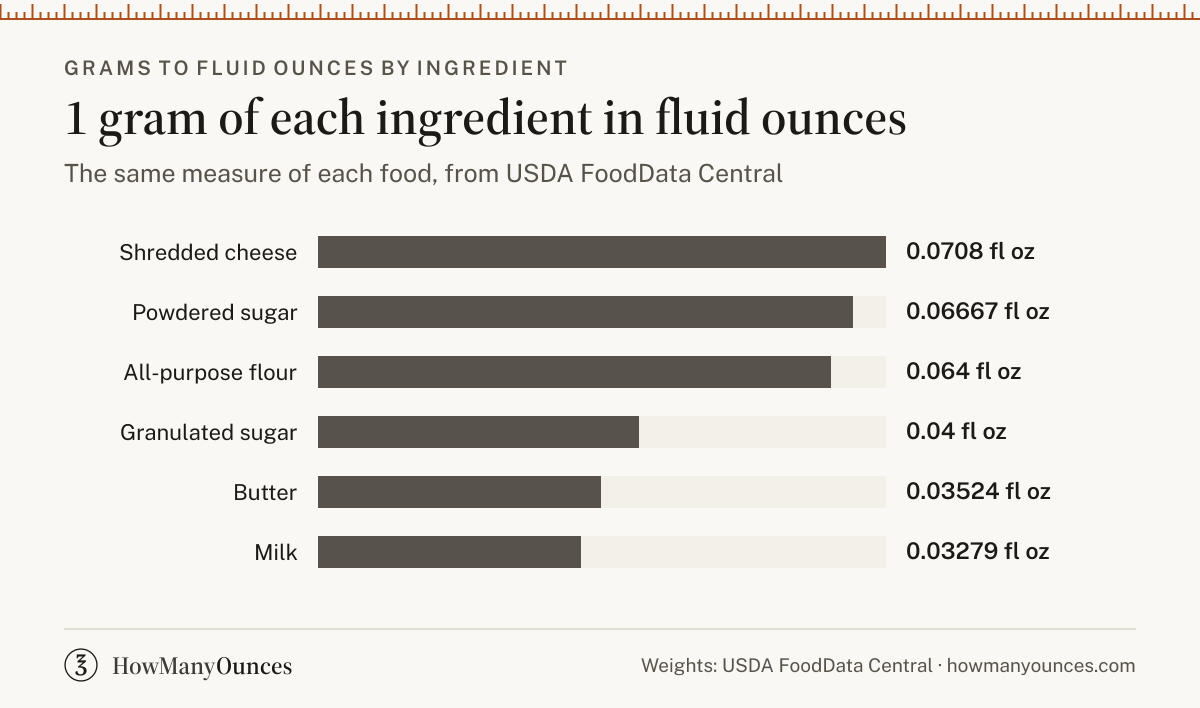
A light powder needs far more room. 50 g of powdered sugar (icing sugar) takes up about 3.33 fluid ounces, while 50 g of water fills only 1.69. Use the water divisor for a powder and you would measure out roughly half the sugar the recipe wants.
| Ingredient | 1 g = |
|---|---|
| All-purpose flour | 0.064 fl oz |
| Granulated sugar | 0.04 fl oz |
| Butter | 0.03524 fl oz |
| Milk | 0.03279 fl oz |
| Powdered sugar | 0.06667 fl oz |
| Shredded cheese | 0.0708 fl oz |
Weighing water for bread dough
When a bread recipe gives the water in grams and you only have a measuring cup, convert before you pour. 350 g of water is about 11.8 fluid ounces, a little under 1 1/2 cups.
Put the cup on the counter and read the marking at eye level. A small misread changes how wet the dough feels, so if you bake the recipe often, a kitchen scale pays for itself in consistency.
Grams and fluid ounces: questions
What is 100 g in fl oz?
About 3.38 US fluid ounces if it is water. Whole milk comes to about 3.28 fluid ounces, and all-purpose flour to about 6.4, since flour needs far more room for each gram.
What is 5 g in fl oz?
About 0.17 US fluid ounce of water, which is close to one teaspoon (4.93 ml). For amounts this small, spoons beat fluid ounces: 5 g of granulated sugar is about 1.2 teaspoons.
How many grams are in 1 ounce?
A weight ounce is exactly 28.349523125 grams, about 28.35 when rounded. Turned around, one gram is only 0.03527 ounce. Both figures are for the ounce on a kitchen scale, not the fluid ounce on a measuring cup.
How do I convert grams to fl oz?
Divide the grams by the weight of one fluid ounce of your ingredient. For water, use the divisor in the formula above; for milk, flour or sugar, pick the ingredient in the converter, which does the division with USDA figures. The fluid ounces to grams page goes the other way.
How many fl oz is 1 kg?
About 33.8 US fluid ounces if the kilogram is water, a little more than four US cups. A kilogram of whole milk takes up about 32.8 fluid ounces. Dry foods take up much more room, so check the ingredient first.
Related conversions
Sources: Unit definitions: NIST Handbook 44 · Densities: USDA FoodData Central · Last reviewed · Report an error
https://howmanyounces.com/grams-to-fluid-ounces/