How Many Liters in a Kilogram?
1 L
1 kilogram of water takes up 1 liter. Lighter or denser ingredients take up more or less, so pick yours in the converter.
Kilograms to Liters conversion chart
| Kilograms | Liters (water) |
|---|---|
| 0.5 kg | 0.5 |
| 1 kg | 1 |
| 2 kg | 2 |
| 3 kg | 3 |
| 4 kg | 4 |
| 5 kg | 5 |
| 10 kg | 10 |
| 15 kg | 15 |
| 20 kg | 20 |
| 23 kg | 23 |
| 25 kg | 25 |
| 30 kg | 30 |
| 40 kg | 40 |
| 45 kg | 45 |
| 50 kg | 50 |
| 55 kg | 55 |
| 60 kg | 60 |
| 65 kg | 65 |
| 70 kg | 70 |
| 75 kg | 75 |
| 80 kg | 80 |
| 85 kg | 85 |
| 90 kg | 90 |
| 95 kg | 95 |
| 100 kg | 100 |
| 110 kg | 110 |
| 120 kg | 120 |
| 150 kg | 150 |
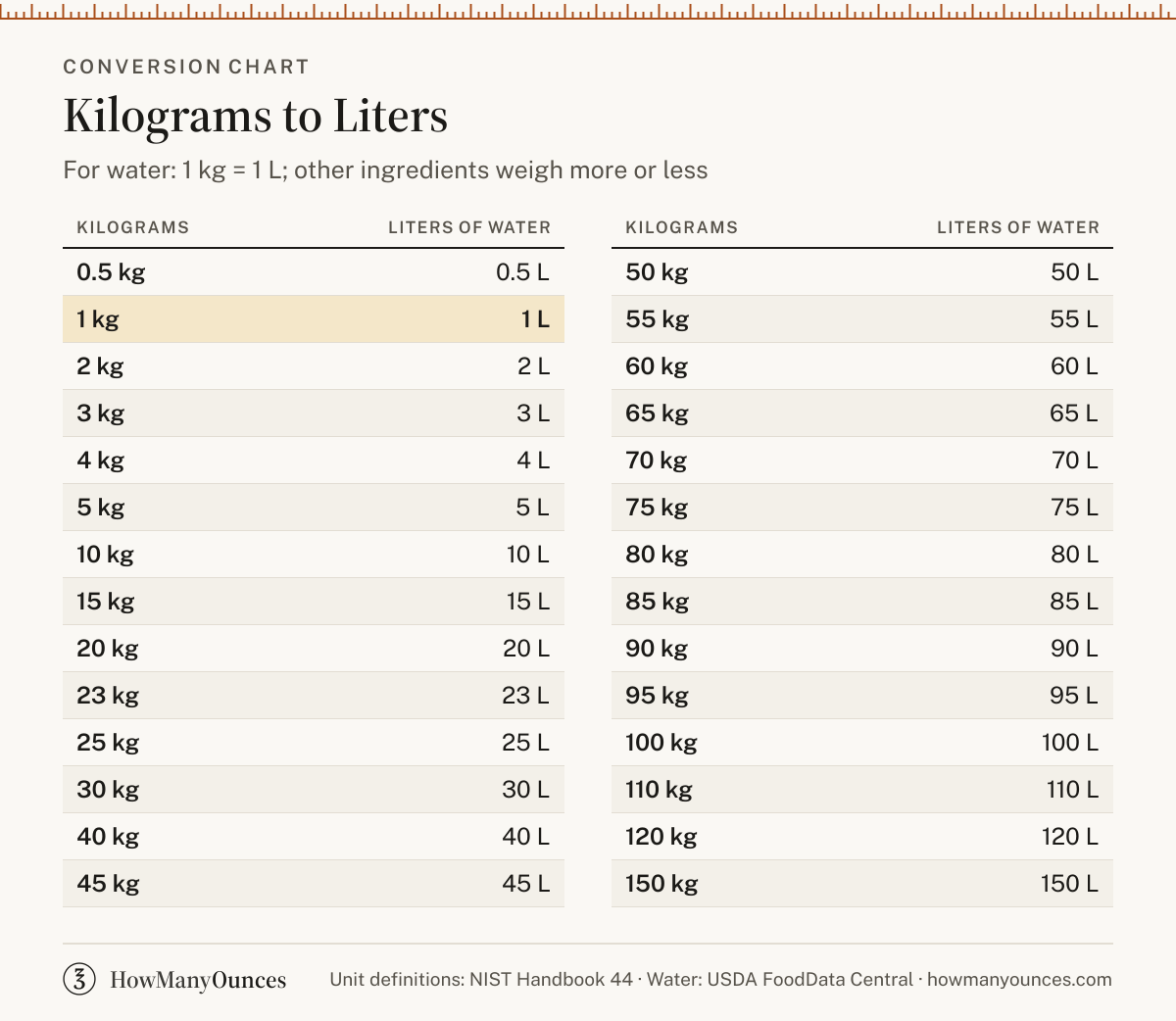
How to convert kilograms to liters
liters = kilograms × 1
Example: 70 kg × 1 = 70 L.
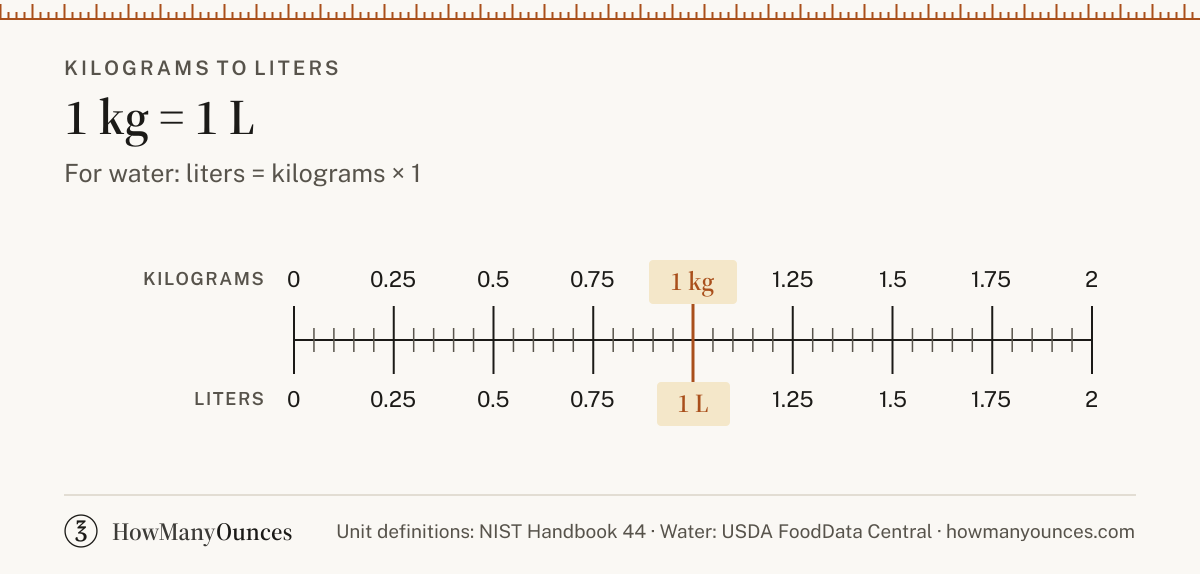
Divide the kilograms by the ingredient's weight per liter. Water weighs 1 kilogram per liter, which is why the formula above is a plain one-to-one swap.
For other foods the divisor changes. A liter of granulated sugar weighs about 0.845 kilogram, so 3 kg of sugar takes up 3 ÷ 0.845 = 3.55 liters. That is more than half a liter beyond what the water rule would suggest.
Going from liters back to kilograms works the same way in reverse: multiply instead of dividing. The liters to kilograms page does that direction.
Why weight depends on the ingredient
The neat match between kilograms and liters belongs to water, not to the units themselves. Change the food and the match breaks.
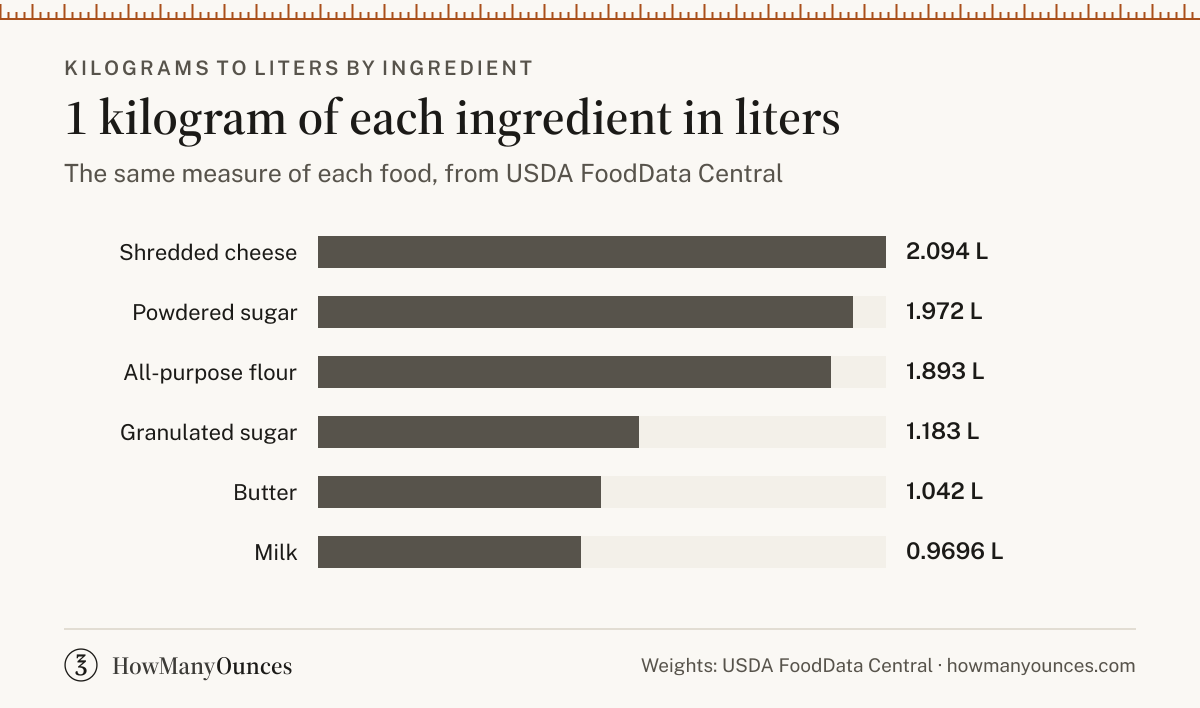
A kilogram of powdered sugar (icing sugar) fills about 1.97 liters, close to twice the space of a kilogram of water. Diced raw potatoes need about 1.58 liters per kilogram, since the pieces leave gaps. Butter comes much closer to water, at about 1.04 liters per kilogram.
| Ingredient | 1 kg = |
|---|---|
| All-purpose flour | 1.893 L |
| Granulated sugar | 1.183 L |
| Butter | 1.042 L |
| Milk | 0.9696 L |
| Powdered sugar | 1.972 L |
| Shredded cheese | 2.094 L |
Is a kilo the same as a kiloliter?
No, even though the names sound alike. A kilo is short for a kilogram, which is a weight. A kiloliter is a volume of 1,000 liters, the space inside a cube one meter on each side.
The two are linked only through water. A kiloliter of water weighs 1,000 kilograms, which is one metric ton. So when a question asks how many liters are in a kiloliter, the answer is a thousand, and no weight is involved at all.
Kilograms and liters: questions
How many liters is 1 kg of flour or sugar?
A kilogram of all-purpose flour takes up about 1.89 liters, and a kilogram of granulated sugar about 1.18 liters. Both take up more than a liter, because these foods are lighter than water for their volume.
How many liters is 1 kg of milk?
About 0.97 of a liter for whole milk, a little under one liter. Milk is slightly heavier than water, so a 1 L carton holds a bit more than a kilogram of milk, about 1.03 kilograms.
Is 1 kg of water exactly 1 liter?
For cooking, yes. This site counts a liter of water as 1 kilogram, the USDA figure. Water is densest near 39 °F (4 °C) and gets slightly lighter per liter as it warms (USGS), but the difference is far too small to notice in a recipe.
How many liters is 5 kg?
It depends on what the 5 kg is. Granulated sugar fills about 5.91 liters, and all-purpose flour about 9.46 liters, nearly twice the space of the same weight of water. Check the ingredient before you pick a container.
Does a kilogram of ice take up more than a liter?
Yes. Water expands as it freezes, and the USGS notes that ice is about 9 percent less dense than liquid water. A kilogram of ice therefore needs roughly a tenth more room than a liter, so leave space when you freeze water or stock.
Related conversions
Sources: Unit definitions: NIST Handbook 44 · Densities: USDA FoodData Central · Last reviewed · Report an error
https://howmanyounces.com/kilograms-to-liters/