How Many Kilograms in a Liter?
1 kg
1 liter of water weighs 1 kilogram. Other ingredients weigh more or less, so pick yours in the converter.
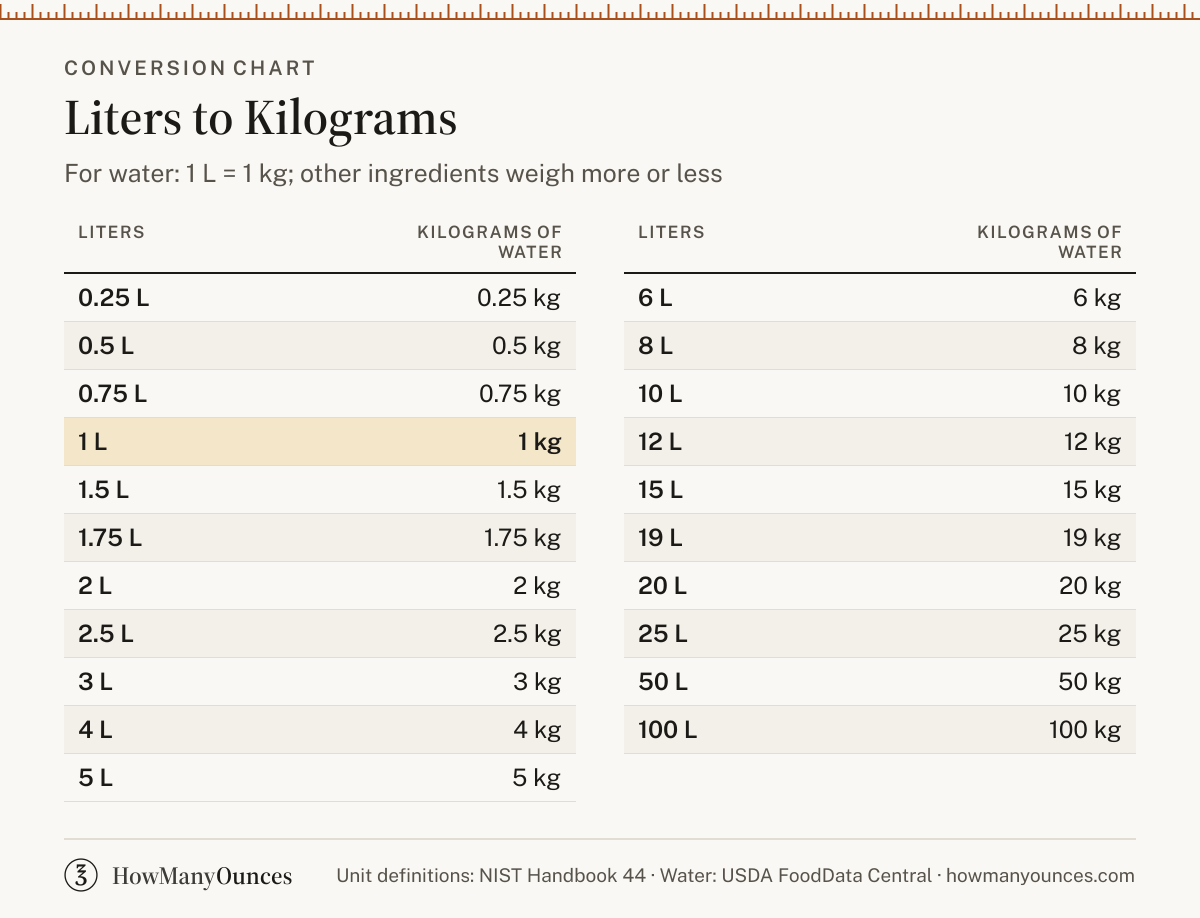
Liters to Kilograms conversion chart
| Liters | Kilograms (water) |
|---|---|
| 0.25 L | 0.25 |
| 0.5 L | 0.5 |
| 0.75 L | 0.75 |
| 1 L | 1 |
| 1.5 L | 1.5 |
| 1.75 L | 1.75 |
| 2 L | 2 |
| 2.5 L | 2.5 |
| 3 L | 3 |
| 4 L | 4 |
| 5 L | 5 |
| 6 L | 6 |
| 8 L | 8 |
| 10 L | 10 |
| 12 L | 12 |
| 15 L | 15 |
| 19 L | 19 |
| 20 L | 20 |
| 25 L | 25 |
| 50 L | 50 |
| 100 L | 100 |
How to convert liters to kilograms
kilograms = liters × 1
Example: 1.5 L × 1 = 1.5 kg.
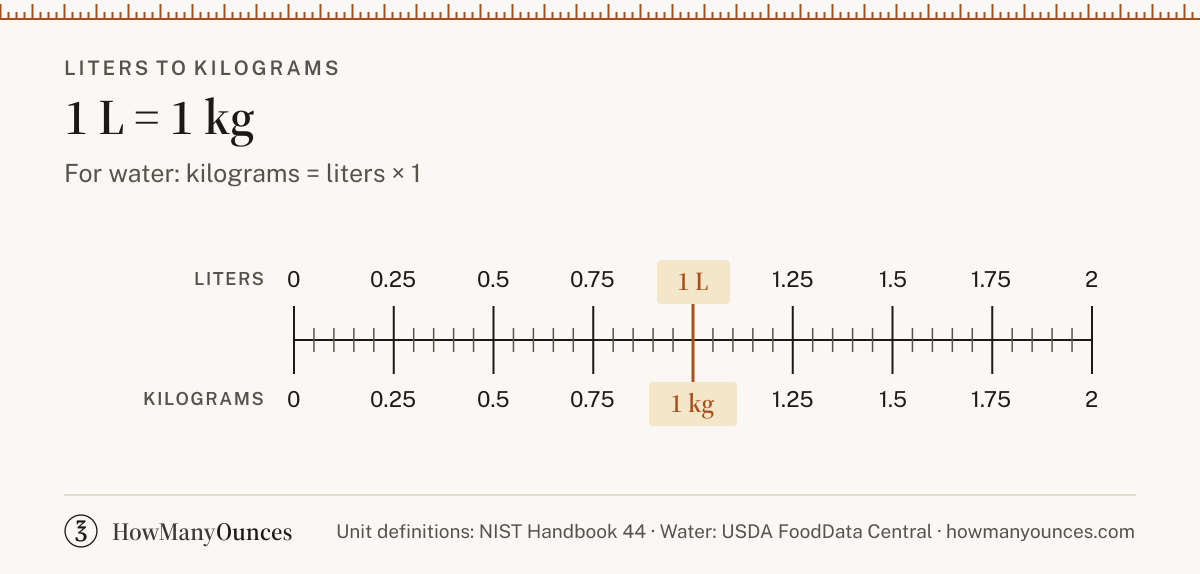
Multiply the liters by the weight in kilograms of one liter of the ingredient. For water the factor is exactly one, as the formula above shows, so the two numbers match.
Whole milk has a factor of about 1.03. A 2 L bottle of milk therefore holds 2 × 1.03 = 2.06 kilograms of milk. Dry foods kept in liter jars need their own, much smaller factors, listed in the table below.
For the opposite direction, divide the kilograms by the same factor, or open kilograms to liters.
Why weight depends on the ingredient
A liter of one food can weigh half as much as a liter of another. The volume stays fixed, but some foods fill every bit of it while others leave gaps.
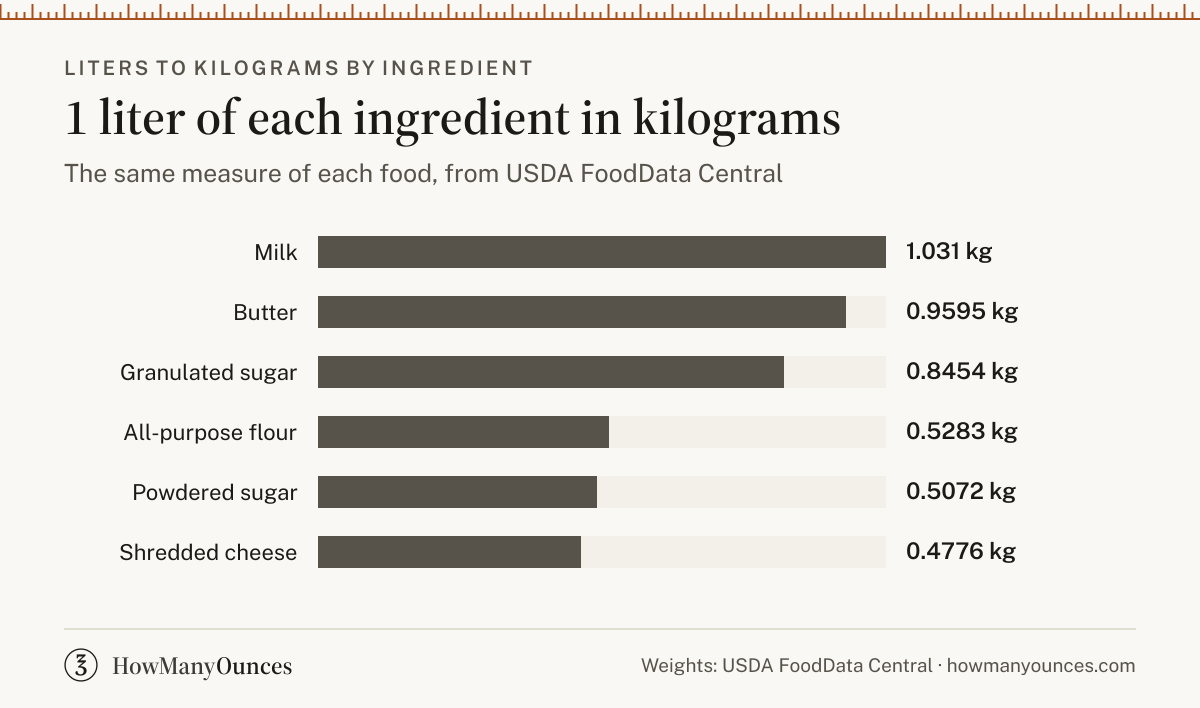
Diced raw potatoes come to about 0.634 kilogram per liter, and whole blueberries to about 0.626 kilogram, because the pieces never pack as tightly as a liquid. Powdered sugar (icing sugar) is lighter still, at about 0.507 kilogram per liter.
| Ingredient | 1 L = |
|---|---|
| All-purpose flour | 0.5283 kg |
| Granulated sugar | 0.8454 kg |
| Butter | 0.9595 kg |
| Milk | 1.031 kg |
| Powdered sugar | 0.5072 kg |
| Shredded cheese | 0.4776 kg |
How heavy is a full water container?
The liters printed on a container tell you how many kilograms of water it holds, which helps before you lift it. A 20 L water container holds about 20 kilograms of water, and a 5 L bottle about 5 kilograms.
Add the container itself on top of that. An empty plastic jug weighs little, but a glass bottle or a metal can adds a noticeable amount, so weigh one empty if you need a close total. On a hike, the same math tells you how much your water bottles add to the pack.
Liters and kilograms: questions
How many kilos is a liter of milk?
About 1.03 kilograms for whole milk, by USDA figures. That is a little more than water. A 1 L carton on a kitchen scale reads a bit higher still, because the carton itself adds weight.
How many kilos is a liter of flour or sugar?
A liter of all-purpose flour weighs about 0.528 kilogram and a liter of granulated sugar about 0.845 kilogram. Both are under a kilogram, so a liter jar of either holds less weight than the same jar of water.
Does a liter of butter weigh a kilogram?
A little less. USDA figures put butter at about 0.959 kilogram per liter. Butter is slightly lighter than water for its size, so a kilogram block takes up a bit more than a liter, about 1.04 liters.
How many liters are in a kiloliter?
A kiloliter is 1,000 liters, so one liter is a thousandth of a kiloliter. The two are volumes, not weights. Filled with water, a kiloliter weighs 1 metric ton, which is where the similar-sounding kilogram sometimes gets mixed in.
Why does my liter of water weigh more than a kilogram on the scale?
The scale is weighing the container too. Put the empty jug or bowl on the scale first and press tare, then pour. The display then shows the weight of the water alone.
Related conversions
Sources: Unit definitions: NIST Handbook 44 · Densities: USDA FoodData Central · Last reviewed · Report an error
https://howmanyounces.com/liters-to-kilograms/