Milliliters to Ounces (ml to oz)
0.03381 fl oz
1 milliliter equals 0.03381 fluid ounce; it takes 29.57 milliliters to make 1 US fluid ounce.
UK: 1 milliliter = 0.0352 imp fl oz
Exact: 1 fl oz = 29.5735295625 ml
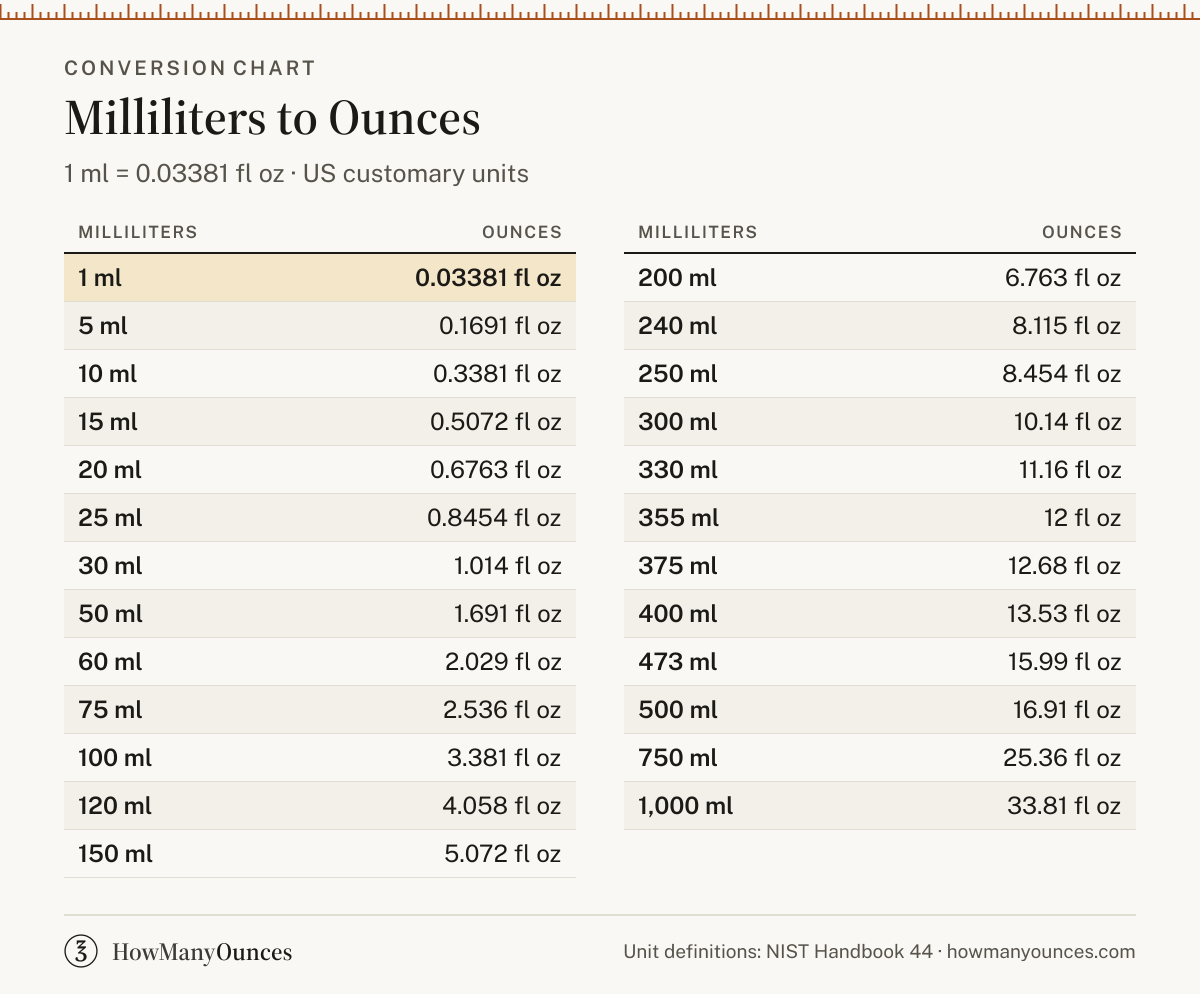
Milliliters to Ounces conversion chart
| Milliliters | Ounces |
|---|---|
| 1 ml | 0.03381 |
| 5 ml | 0.1691 |
| 10 ml | 0.3381 |
| 15 ml | 0.5072 |
| 20 ml | 0.6763 |
| 25 ml | 0.8454 |
| 30 ml | 1.014 |
| 50 ml | 1.691 |
| 60 ml | 2.029 |
| 75 ml | 2.536 |
| 100 ml | 3.381 |
| 120 ml | 4.058 |
| 150 ml | 5.072 |
| 200 ml | 6.763 |
| 240 ml | 8.115 |
| 250 ml | 8.454 |
| 300 ml | 10.14 |
| 330 ml | 11.16 |
| 355 ml | 12 |
| 375 ml | 12.68 |
| 400 ml | 13.53 |
| 473 ml | 15.99 |
| 500 ml | 16.91 |
| 750 ml | 25.36 |
| 1,000 ml | 33.81 |
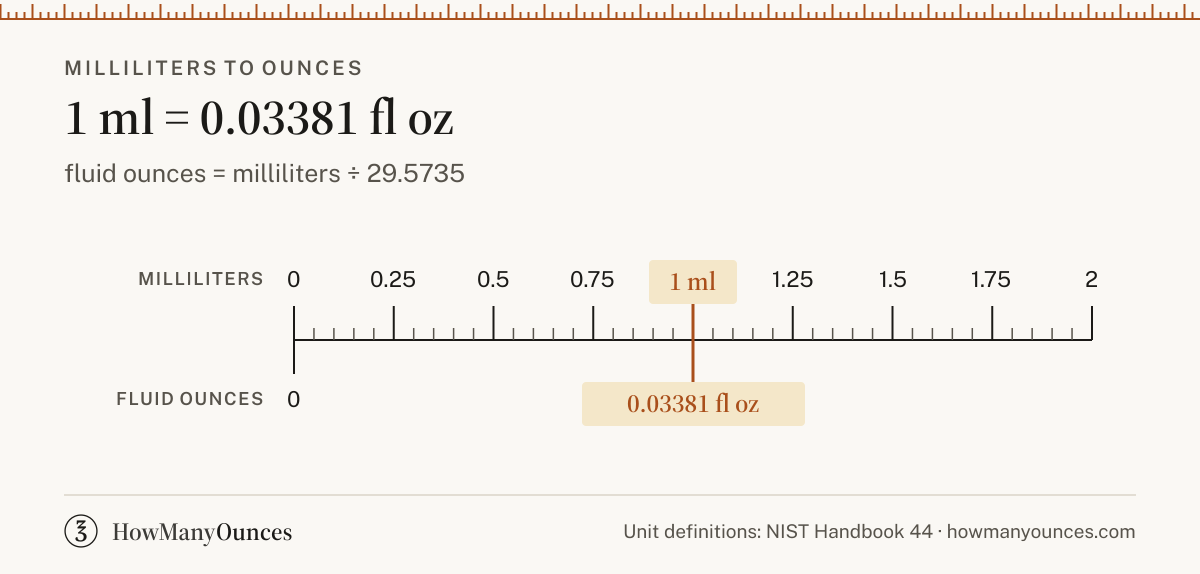
How to convert milliliters to ounces
fluid ounces = milliliters ÷ 29.5735
Example: 350 ml ÷ 29.5735 = 11.83 fl oz.
Divide the milliliters (millilitres) by 29.57 to get US fluid ounces. For a quick estimate, divide by 30 instead; the answer comes out a little low, but close enough to compare two bottles on a shelf.
A 50 ml tube of lotion holds 1.691 fl oz, and a 200 ml carton holds 6.763 fl oz. For a whole liter or more, the milliliters to liters converter keeps the numbers shorter.
The result is a fluid ounce, a unit of volume. It says how much space the liquid takes up, not what it weighs on a scale.
US vs UK fluid ounces
The British fluid ounce is slightly smaller, 28.41 ml, so the same milliliters give a higher count there. A 500 ml bottle is 16.91 fl oz in US measure but 17.6 imp fl oz in imperial measure.
If an older British cookbook lists fluid ounces, it means this smaller size, defined as exactly 28.4130625 ml. Divide the milliliters by 28.41 to match it.
| Unit | Size | Used in |
|---|---|---|
| US fluid ounce | 29.57 ml | US |
| imperial fluid ounce | 28.41 ml | UK |
Reading a label in ml and fl oz
US food labels must state the amount in both metric and US units, according to the FDA Food Labeling Guide. That is why a bottle of juice or water usually prints both numbers side by side.
The fluid ounce figure on a label is rounded. A bottle marked 500 ml works out to 16.91 fl oz, which a label may print as 16.9 fl oz. When two products list different ounce figures for the same ml size, trust the milliliters.
Milliliters and ounces: questions
Is 30 ml the same as 1 fl oz?
Almost. 30 ml is 1.014 fl oz, just over one US fluid ounce. US nutrition labels round a fluid ounce to 30 ml under FDA labeling rules, which is where the round figure comes from.
How many ml make 1 oz?
It depends on the ounce. A US fluid ounce takes just under 30 ml, as the converter above shows, and a British fluid ounce takes 28.41 ml. An ounce of weight has no fixed volume: an ounce of water fills about 28.3 ml, while an ounce of all-purpose flour fills about 54 ml.
Is 100 ml the same as 4 oz?
No. 100 ml is 3.381 fl oz, a little under three and a half US fluid ounces. Four fluid ounces take 118.3 ml, which is half a US cup, so a 100 ml bottle holds noticeably less.
Is 100 ml the same as 1 oz?
No, 100 ml holds more than three US fluid ounces, not one. A single fluid ounce falls just short of the 30 ml line on a small measuring glass. Even three one-ounce bottles hold only 88.72 ml.
How many ounces is 8 ml?
8 ml is 0.2705 fl oz, a little more than a quarter of a US fluid ounce. In kitchen spoons, that is 1.623 tsp, or just over one and a half teaspoons.
Related conversions
Sources: Unit definitions: NIST Handbook 44 · Last reviewed · Report an error
https://howmanyounces.com/milliliters-to-ounces/