Fluid Ounces to Ounces (fl oz to oz)
1.043 oz
1 US fluid ounce of water weighs 1.043 ounces. Other ingredients weigh more or less, so pick yours in the converter.
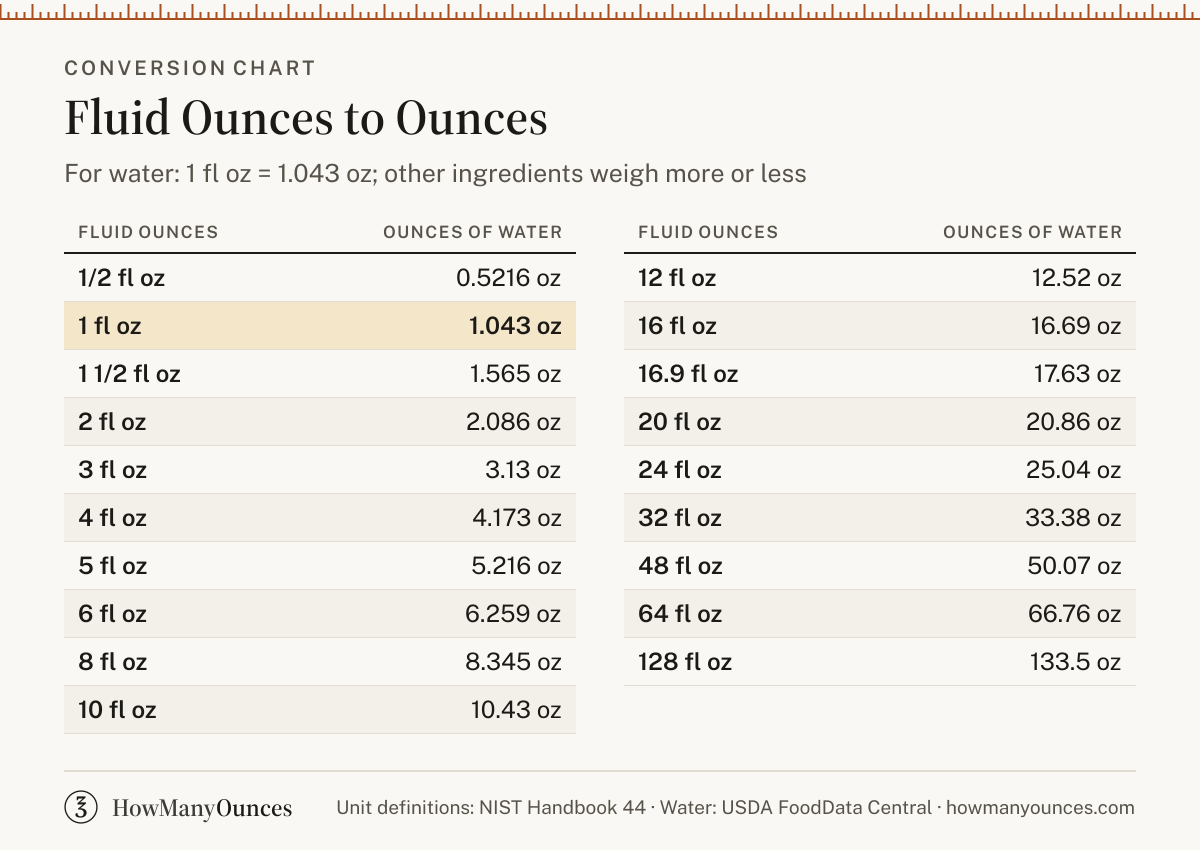
Fluid Ounces to Ounces conversion chart
| Fluid Ounces | Ounces (water) |
|---|---|
| one half fluid ounce | 0.5216 |
| 1 fl oz | 1.043 |
| 1 and one half fluid ounces | 1.565 |
| 2 fl oz | 2.086 |
| 3 fl oz | 3.13 |
| 4 fl oz | 4.173 |
| 5 fl oz | 5.216 |
| 6 fl oz | 6.259 |
| 8 fl oz | 8.345 |
| 10 fl oz | 10.43 |
| 12 fl oz | 12.52 |
| 16 fl oz | 16.69 |
| 16.9 fl oz | 17.63 |
| 20 fl oz | 20.86 |
| 24 fl oz | 25.04 |
| 32 fl oz | 33.38 |
| 48 fl oz | 50.07 |
| 64 fl oz | 66.76 |
| 128 fl oz | 133.5 |
How to convert fluid ounces to ounces
ounces = fluid ounces × 1.04318
Example: 12 fl oz × 1.04318 = 12.52 oz.
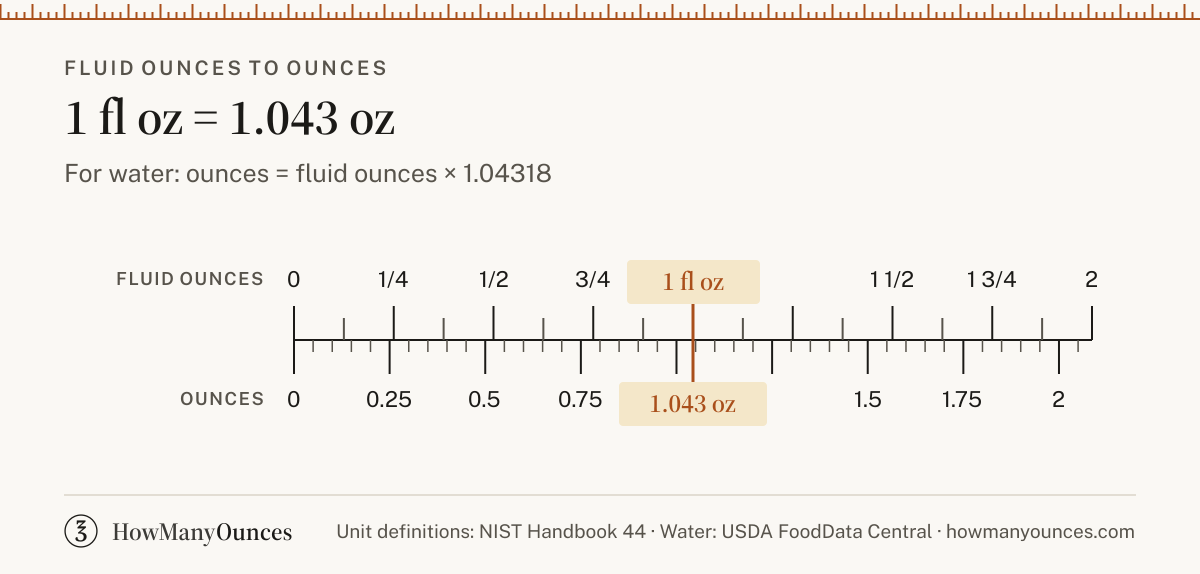
First make sure you really have two different ounces. A fluid ounce is read off a measuring cup or a bottle, and an ounce is read off a scale. The factor above converts one into the other for water.
For a 16 fl oz bottle of water, the weight is about 16.7 ounces. Other foods need their own factor, the weight in ounces of one fluid ounce of that food. Whole milk comes to about 1.08 ounces per fluid ounce, granulated sugar to 0.88 and all-purpose flour to only 0.55.
Multiply the fluid ounces by that factor to get ounces of weight. To go back, divide instead, or use the ounces to fluid ounces page.
US vs UK fluid ounces
The British imperial fluid ounce sits even closer to the weight ounce. Filled with water it weighs 1.002 ounces, so in a UK recipe a fluid ounce of water and an ounce of water are practically the same amount.
The US fluid ounce is a little larger than the imperial one. That is why a US fluid ounce of water weighs slightly more than an ounce, and why the gap grows as the amounts get bigger.
| Unit | Size | Used in |
|---|---|---|
| US fluid ounce | 29.57 ml | US |
| imperial fluid ounce | 28.41 ml | UK |
Why weight depends on the ingredient
The two units share a name but do different jobs. A fluid ounce tells you how much room something takes up, and an ounce tells you how heavy it is. Water lines up with the weight ounce almost one to one, so the names seem interchangeable.
Most dry foods break that match. A fluid ounce of powdered sugar weighs about 0.53 ounce, only about half of what the name suggests. Shredded cheese is similar: a cup of it, which is eight fluid ounces, weighs about 4 ounces.
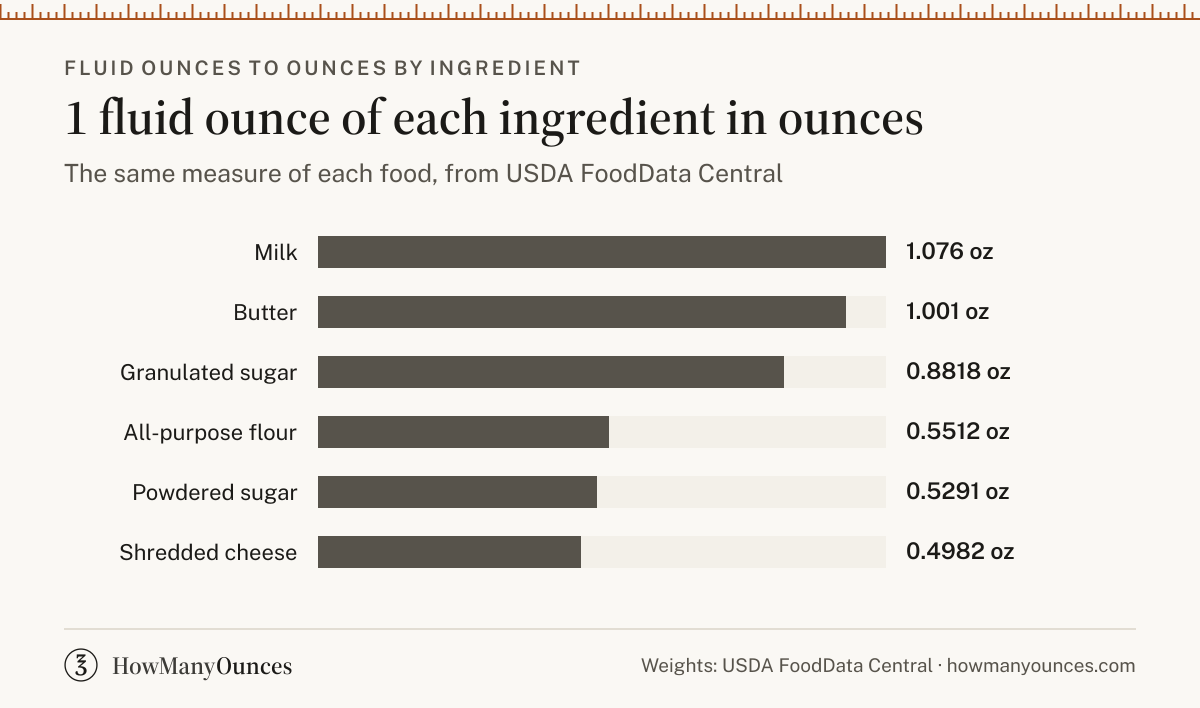
| Ingredient | 1 fl oz = |
|---|---|
| All-purpose flour | 0.5512 oz |
| Granulated sugar | 0.8818 oz |
| Butter | 1.001 oz |
| Milk | 1.076 oz |
| Powdered sugar | 0.5291 oz |
| Shredded cheese | 0.4982 oz |
Why do food labels use both oz and fl oz?
US labels follow a rule about which ounce to print. The FDA Food Labeling Guide says the net quantity of a liquid food is generally given in fluid measure, such as fl oz, and that of a solid, semisolid or viscous food in weight.
So a bottle of juice shows fluid ounces, while a jar of peanut butter or a bag of chips shows ounces of weight. Only the second number can be checked on a kitchen scale.
Fluid Ounces and ounces: questions
Is a fluid ounce the same as an ounce?
No. A fluid ounce measures volume and an ounce measures weight. The two match closely only for water and foods of similar density, such as milk and butter. A fluid ounce of all-purpose flour, for example, weighs only about 0.55 ounce.
Does 8 fl oz weigh 8 oz?
Close to it for water, but not for most other foods. Eight fluid ounces of water, one US cup, weigh about 8.35 ounces. A cup of whole milk weighs about 8.61 ounces, while a cup of flour weighs just 4.41 ounces and a cup of sugar about 7.05.
How many ounces does a fluid ounce of butter weigh?
About one ounce. The USDA cup weight for butter works out to 1 ounce per fluid ounce. The US stick shows this neatly: one stick is 4 fluid ounces by volume and 4 ounces, a quarter pound, by weight.
How many ounces does a fluid ounce of milk weigh?
About 1.08 ounces for whole milk, using the USDA cup weight. That is a little heavier than water. The extra adds up in large amounts, so 32 fl oz, one US quart, of milk weigh about 34 ounces.
Should I measure dry ingredients in fl oz or oz?
Follow the recipe: if it gives ounces for flour, sugar or chocolate, it means weight, so use a scale. If it gives cups or fluid ounces, use measuring cups and level them off. Swapping one for the other without converting can throw a bake off by a wide margin.
Related conversions
Sources: Unit definitions: NIST Handbook 44 · Densities: USDA FoodData Central · Last reviewed · Report an error
https://howmanyounces.com/fluid-ounces-to-ounces/